Fleet

Most fleet damage happens under ten miles an hour, in a yard or at a kerb, to a vehicle whose driver could not see the thing they hit.

Solution 03 Box trucks & delivery In development
// 01. The situation

A mirror clipped on a gate, a rear corner into a loading dock post, a bollard that was never in any mirror. Small, constant, and they share a cause: a box body has no rear window and two mirrors that cannot be looked at simultaneously.
// 02. What it changes
01 Yard and dock The whole envelope while reversing, with range on the posts and the trailer beside you.
02 Kerbside The nearside as volume, where a cyclist is least visible and most at risk.
03 Record The reconstruction is data, so an incident has a record of what was around the vehicle and where, rather than a fisheye clip.
04 New drivers Manoeuvres that take a year of seat time to judge become visible in week one.
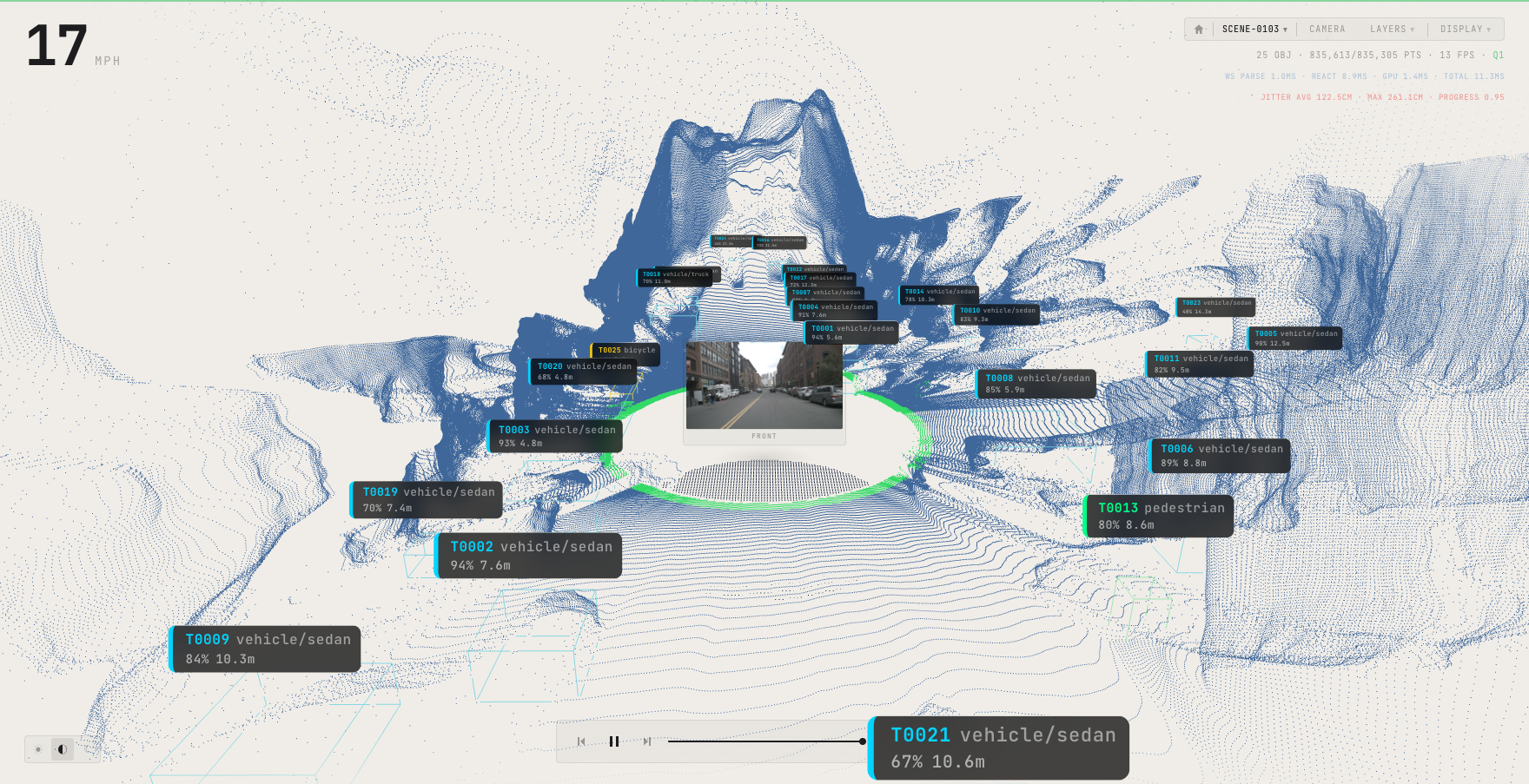
// 03. Tracked, with range recorded street scene
A reconstructed street scene as a point cloud with 25 tracked
              vehicles and pedestrians, each labelled with class, confidence
              and distance in metres.
25 objects held across frames, each with class, confidence and range. Identity survives one object passing behind another.
// 04. Status nothing to pilot yet

No product to pilot yet. The stack runs on recorded street data, and no vehicle install exists. A fleet deployment also needs durability, a fit that does not take a van off the road for a day, and evidence it survives a wash cycle and a winter.

Useful now is the shape of your problem: fleet size, vehicle type, and what low-speed damage costs you in a year.

Talk to me about a pilot

An email address and a sentence about the fleet. No payment, no commitment, no date.

Stored to reply to you. Not sold, not shared.