Road
marker
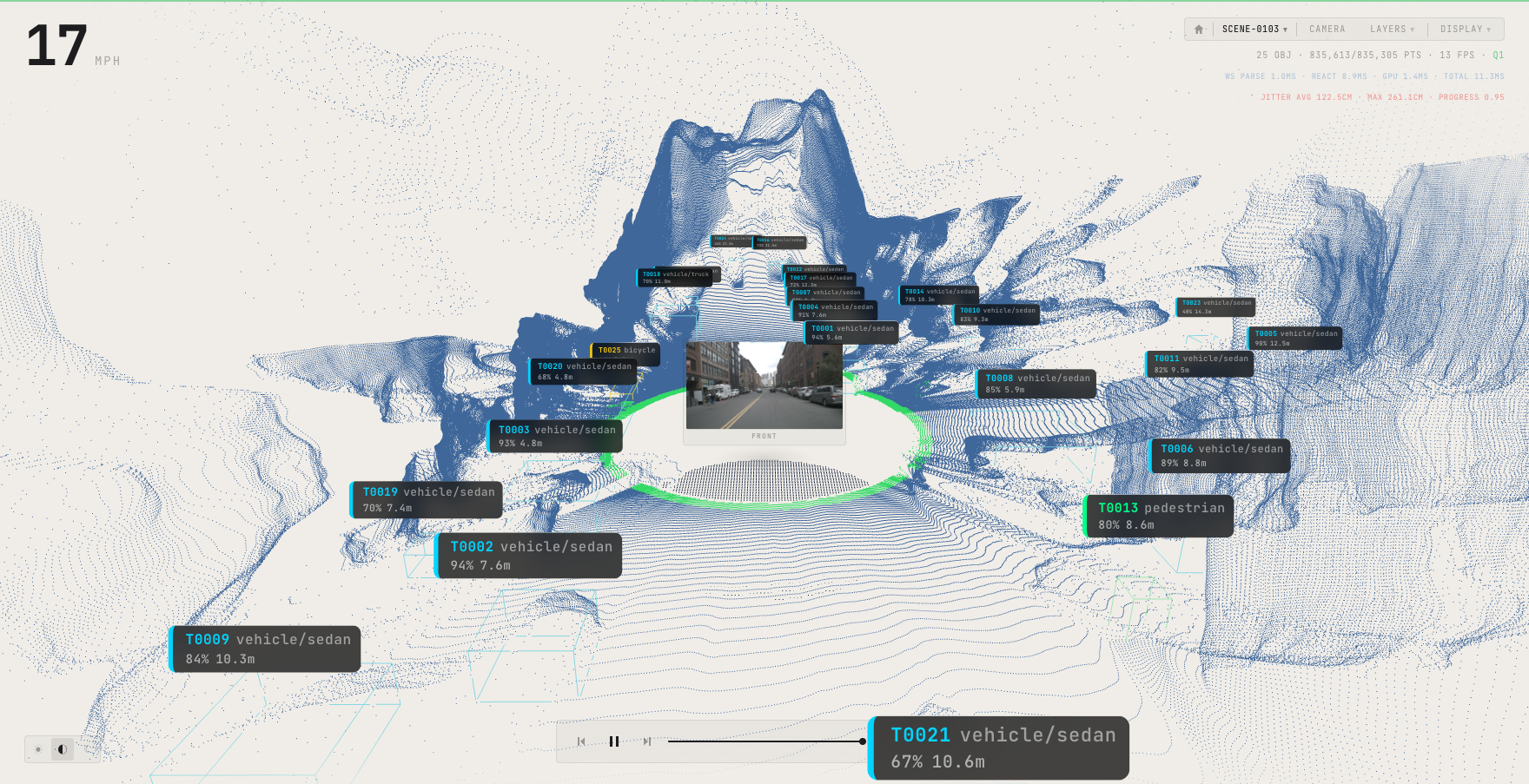
Surround cameras in, a live 3D map of everything around your vehicle out. See the curb, the rock, the post and the cyclist as solid volume rather than as a smeared fisheye picture.
A backup camera shows you a picture. Driving something large needs a volume: what is solid, where it ends, and how much room is left. The wider the vehicle and the worse the sightlines, the more of that volume you are guessing at.
Roadmarker takes six cameras mounted around the vehicle and reconstructs the space as occupied and free, then tracks what moves through it and holds identity on each thing across frames. A road marker is what makes a route followable when the road itself will not tell you where it goes.
Vans & RVs
Park a long wheelbase in a real space. See the bollard, the low branch and the drop at the back of the site without leaning out of a window.
Read more → 02Overland
Pick a line over rock and ruts with the ground under the sills drawn in, including the part the hood hides.
Read more → 03Fleet
Cut low-speed damage on box trucks and delivery vans, and keep a record of what the vehicle could actually see.
Read more →Compute unit
A sealed box that runs the perception stack on the vehicle. No cloud in the loop, because a system you rely on while reversing cannot wait on a cell signal.
Camera set
Six cameras with known optics and mounting hardware. The geometry has to be known to reconstruct from it, which is why the cameras come with the system rather than from a parts bin.
Display
Use an iPad you already own, or add a mounted screen. The iPad app is built and reads the same data the wired display does.
- Points per frame
- 835,613
- Render
- 13 FPS
- Frame budget
- 11.3 MS TOTAL
- Tracked objects
- 25 IN FRAME
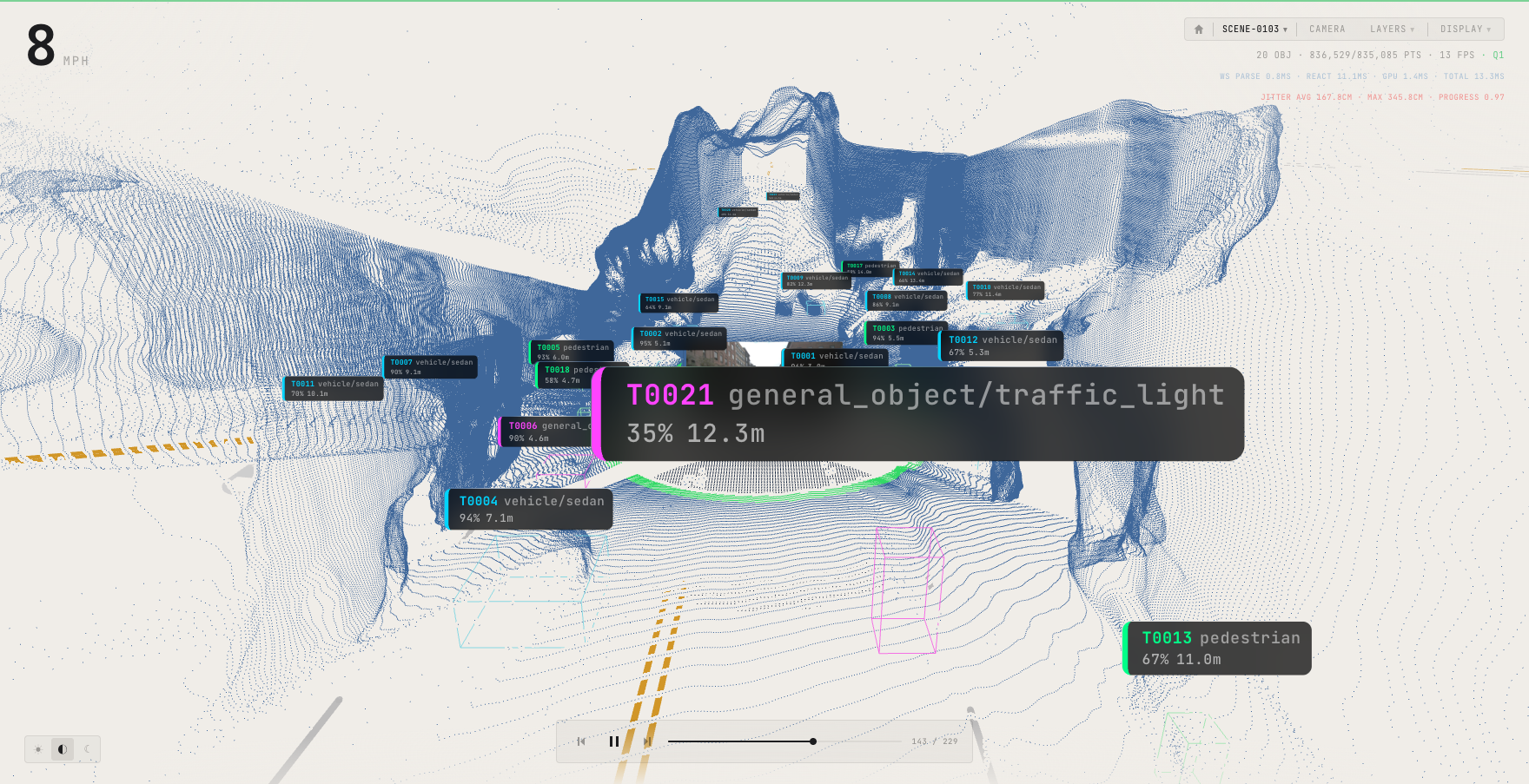
No hardware exists yet, and nothing above is a product you can buy. The pictures on this page are the real system running, and what it is running on is recorded street data from a research dataset, not a camera bolted to a van. That is the honest state of it.
What is built: the perception and reconstruction stack, the tracking, the desktop renderer, and a native iPad app reading the same data. What is not: a live camera rig, an enclosure, and everything that turns a working pipeline into something you mount on a vehicle.
The next milestone is running live cameras through it. The system is built so that swapping recorded frames for a live rig touches one layer, which is a design decision rather than a lucky one, but nobody has done it yet.
Tell me when it is real
An email address, nothing else. No payment, no reservation, no delivery date, because promising one would be inventing it. You will hear when a rig runs on a real vehicle.
One address, stored to email you once. Not sold, not shared, not added to anything else.